Written by Ewa Mikrut, BACP Member & Expressive Arts Counsellor specialising in ADHD, autism in children, young people and adults.
If you've just walked away from another bedtime standoff wondering whether you're too strict, too soft, or simply doing it all wrong, you're not failing at setting boundaries with children. You're in the middle of one of parenting's hardest, most ordinary struggles, and it's one of the questions I hear most often in online sessions with families across the UK. A boundary isn't a wall you build to keep your child out. It's a container that holds them, so their big feelings have somewhere safe to land. Children don't push against boundaries because they want to break them. They push because testing the edges is how they find out the edges are real.
Why do children test boundaries in the first place?
A boundary, in simple terms, is a clear and consistently held limit that tells a child what is and isn't okay for their body, their behaviour, and their relationships with others. Psychologists at the Child Mind Institute describe boundaries as being fundamentally about understanding and respecting our own needs while remaining respectful of the needs of others: a skill that takes years, not days, to build.
When a child tests a boundary, they are rarely doing it to be difficult. More often, they're checking whether the limit still holds, the way you might press on a bridge railing before leaning on it. If it wobbles, you press harder next time. If it holds, you relax.
This is why boundaries that shift depending on your mood, your energy, or whether you're in public tend to get tested the most. It isn't that your child is manipulative. It's that an inconsistent boundary reads as an unsolved question, and children keep asking questions until they get a reliable answer.
Seen this way, a boundary isn't a punishment or a power move. It's a statement of care, a way of saying “I see you, and I'm going to hold this steady so you don't have to.” That's what setting boundaries with children really comes down to: not control, but care held steady.
How do boundaries actually help a child feel safe?
Children's nervous systems are still learning what safety feels like. A held boundary, calm, predictable and repeated, teaches the body that the world has edges it can rely on. Without that, even small decisions can feel enormous, because nothing tells a child where one thing ends and another begins.
In sessions, I often notice that children push hardest against the boundaries that were held least consistently, not the strictest ones. Predictability, far more than strictness, is what actually settles a dysregulated nervous system. A child who knows exactly what will happen when they throw the toy can afford to have the feeling that made them want to throw it in the first place.
Warmth matters here as much as the limit itself. A boundary delivered coldly teaches a child to fear the edge. A boundary held warmly, something like “I won't let you hit your brother, and I'm right here with you while this feeling passes,” teaches them that the edge and the care can exist in the same moment. That combination, held together, is what actually helps a child feel safe enough to let a big feeling move through them instead of getting stuck.
How can I hold a boundary without shouting or punishing?
Setting boundaries with children rarely goes wrong because parents don't know what the boundary should be. Most struggle with holding it in the moment their child is already crying, hitting, or refusing to move from the shop floor. A few things help in that exact moment:
- Name it simply, once. “I won't let you throw the blocks. Blocks stay on the floor.” One clear sentence, not a lecture. Children in a big feeling can't process a paragraph.
- Stay physically close. Child psychologists at the Child Mind Institute note that boundary and social coaching works best in real time, right when the behaviour happens, not as a debrief an hour later.
- Name the feeling underneath the behaviour. “You're really frustrated the tower fell.” This tells your child you're holding both things at once: the limit and their experience.
- Offer a choice inside the limit. “You can stack the blocks again, or draw how frustrated you feel. Which one first?” This keeps the boundary intact while giving your child some agency back.
- Follow through, gently and without apology. A boundary you cave on becomes a boundary your child will test twice as hard next time.
Creative arts often become genuinely useful here, not as a trick to calm a child down, but because a crayon or a piece of clay can hold a feeling that's too big for words yet. Sometimes a child can't tell you why the boundary made them so angry, but they can show you in a scribble of red across the page. That image becomes something you can sit with together, once the feeling has passed.
What does boundary-setting look like for neurodivergent children?
Setting boundaries with children looks a little different for autistic children and children with ADHD, though the warmth and consistency stay the same, often taking a different shape. Predictability matters even more, because an unclear boundary asks a child to guess, and guessing is exhausting for a brain already working hard to process the world.
A few adjustments tend to help:
- Make boundaries visible, not just spoken. A visual schedule, a timer, or a simple drawn cue can hold a limit more reliably than words alone, especially for a child who finds verbal instructions hard to process in the moment.
- Respect body autonomy explicitly. Never force a hug or physical affection, even from a well-meaning relative. Offer an alternative, such as a high five, a wave or a fist bump, so the child learns their body's limits are respected, not overridden for someone else's comfort.
- Separate impulsivity from defiance. A child with ADHD who blurts out or grabs something isn't ignoring the boundary out of disrespect; their brain often acts before the boundary has had time to register. The response that helps is patient repetition, not consequence.
- Build in transition time. Autistic children often need more warning before a boundary changes something in their environment. Saying “in five minutes, screen time finishes” once isn't the same as saying it with a visual timer running alongside it.
None of this means the boundary itself is different. It means neurodivergent children (natural variations in how people think, feel and learn, not deficits to correct) may need more scaffolding to meet the same limit, and that scaffolding is a form of respect, not a lowering of expectations.
Can a parent be both warm and firm at the same time?
This question sits underneath most of the others, and it's worth pausing on rather than rushing past. Many parents grew up with boundaries that were either rigid and cold, or warm but shapeless, and it can feel, at first, like you have to choose one or the other for your own child.
You don't. A boundary held with warmth isn't a softer boundary; it's simply a more human one. It says the limit is real and you are not alone in bumping up against it. That's a harder thing to hold than either extreme, because it asks you to stay calm and connected at exactly the moment your child is neither. But it's also the version that a child's nervous system trusts most, over time, not because it's permissive, but because it never asks the child to choose between being loved and being held to a limit.
Frequently Asked Questions
At what age should I start setting boundaries with my child?
From toddlerhood, in simple, physical forms: “gentle hands,” “we sit for dinner.” Boundaries don't need language to begin; a calm, consistent response to a behaviour teaches the limit long before a child can talk about it.
What's the difference between a boundary and a rule?
A rule tells a child what to do. A boundary tells them what you will and won't allow, accept, or take part in, and it's something you hold rather than something you enforce on them. Rules can be negotiated; boundaries, once set, need to be held consistently to mean anything.
Is it normal for my child to get angry when I set a boundary?
Yes, and it's often a sign the boundary is working, not failing. A boundary interrupts a child's momentum, and the feeling that follows (anger, tears, protest) is the natural response to that interruption, not evidence you've done something wrong.
How do I set boundaries without damaging my relationship with my child?
Boundaries damage a relationship far less than inconsistency does. A child can trust a parent who holds a firm, warm limit even while they're upset with them; what erodes trust is a boundary that changes depending on how tired or frustrated you are.
How can creative arts help with boundary-setting at home?
Drawing, movement or storytelling give a child a way to process the feelings a boundary brings up (frustration, disappointment, relief) without needing the words for them yet. It's not a technique to end a tantrum faster; it's a way of letting the feeling be seen and held.
A note on professional support
This article offers general guidance and reflects patterns I see often in my work. It isn't a substitute for individual assessment or support. If boundary-setting at home feels consistently overwhelming, or your child's distress feels bigger than the situation calls for, it's worth speaking to your GP or a qualified children's mental health professional. You can also find further information and support through Young Minds, the UK's leading charity for children and young people's mental health.
If any of this resonates, if you're tired of feeling like every boundary turns into a battle, I'd love to hear from you. You can book a free 20-minute introductory call to find out whether working together, in person or online, feels right for your family.
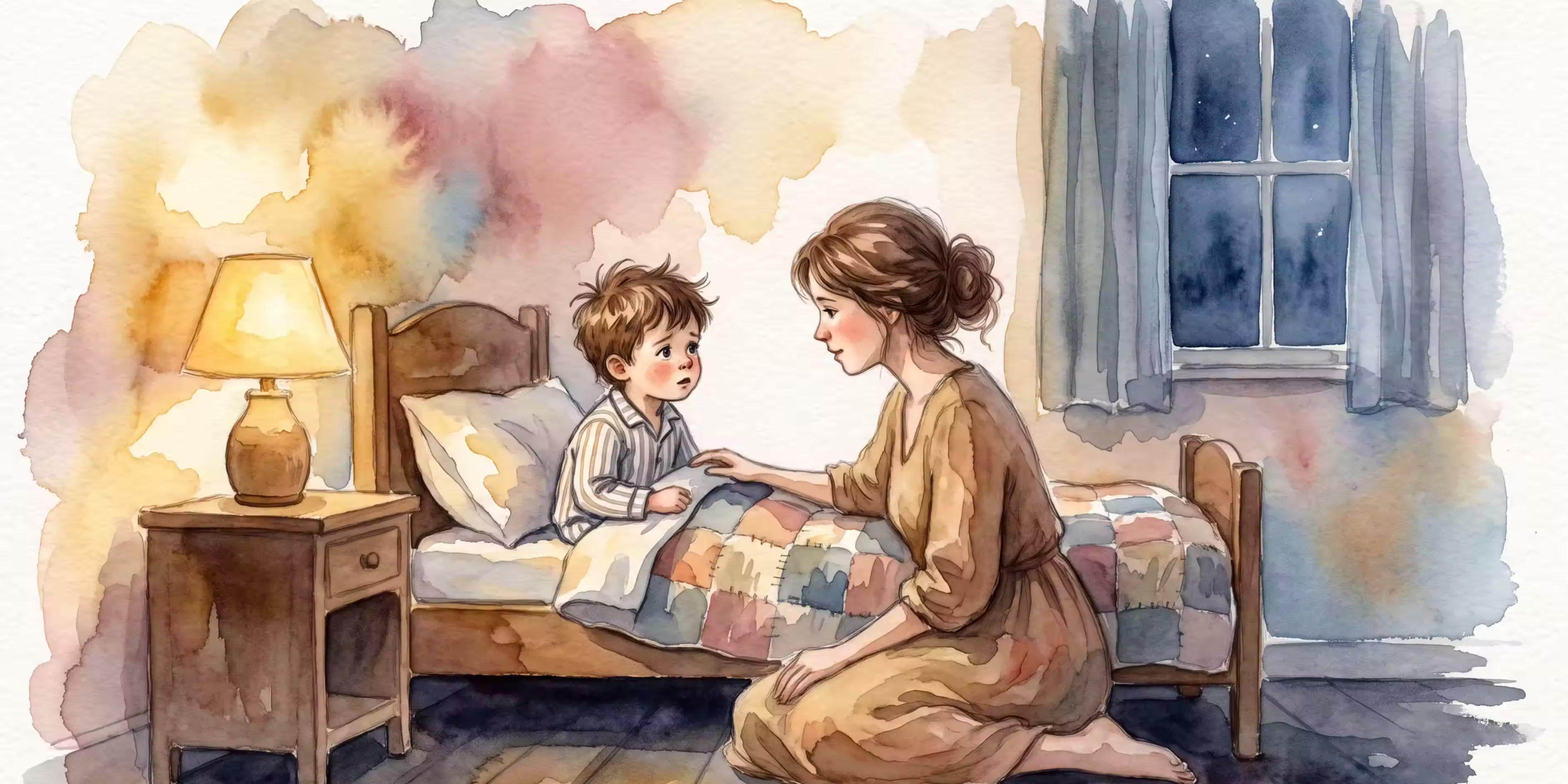
A note on the image above: the illustration paired with this post is an original Waldorf-style watercolour, painted specifically for this piece, a mother kneeling on the floor beside her son's bed, warm lamplight against the cool blue of the night outside. It sits alongside the article as a felt image of what a boundary can be: not a wall, but something that holds, someone steady, right there, while a big feeling passes.